
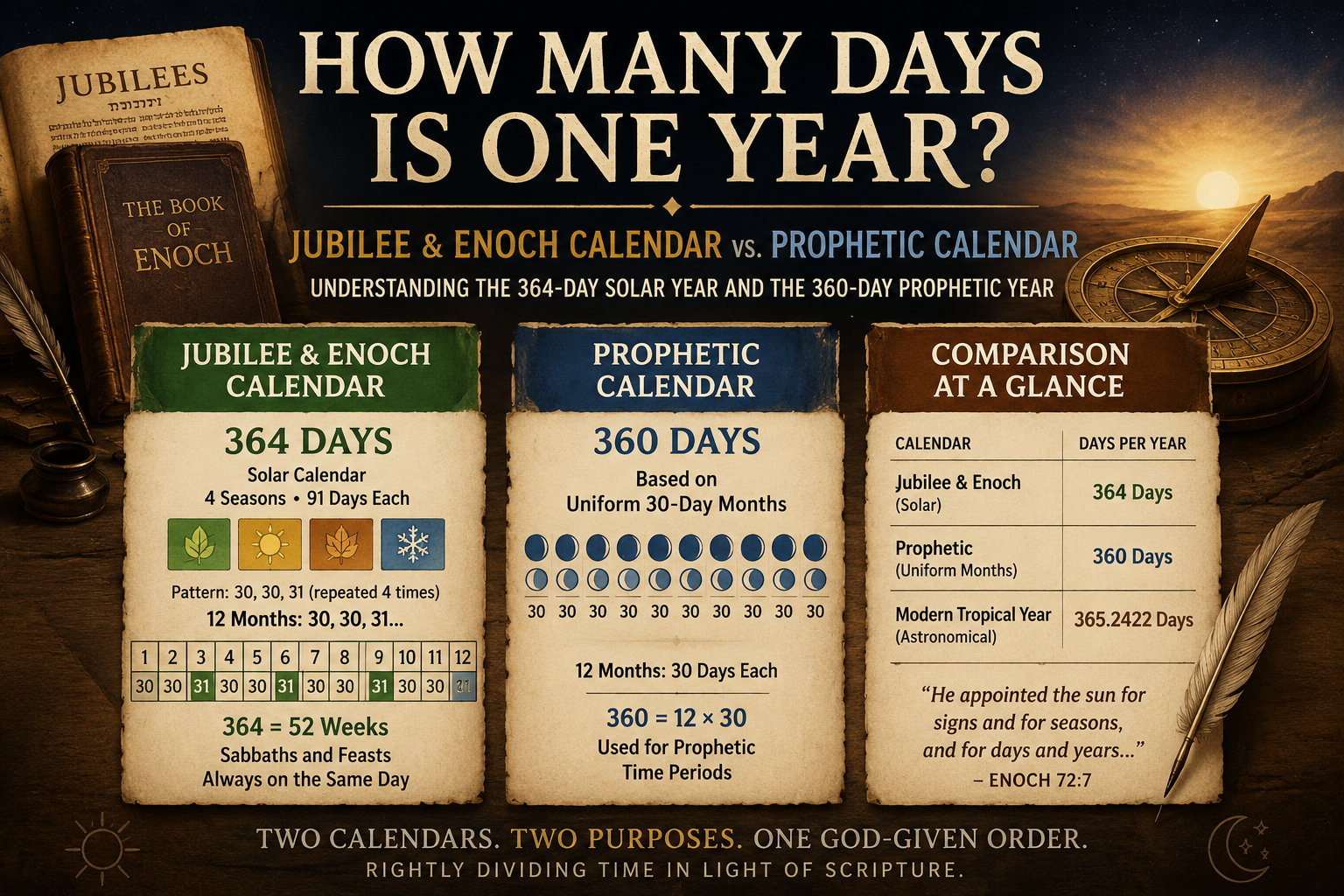
According to both the Book of Jubilees and the Book of Enoch, one year consists of 364 days.
Here’s the breakdown:
The Enoch Calendar
The Book of Enoch describes a 364-day solar calendar.
It is divided into:
- 4 seasons
- 91 days per season
- Total:
- 91 × 4 = 364 days
Each season consists of:
- 30 days
- 30 days
- 31 days (the extra day marks the end of the season)
So the pattern is:
| Month | Days |
|---|---|
| Month 1 | 30 |
| Month 2 | 30 |
| Month 3 | 31 |
| Month 4 | 30 |
| Month 5 | 30 |
| Month 6 | 31 |
| Month 7 | 30 |
| Month 8 | 30 |
| Month 9 | 31 |
| Month 10 | 30 |
| Month 11 | 30 |
| Month 12 | 31 |
Total = 364 days
The Jubilee Calendar
The Book of Jubilees uses the same 364-day solar calendar and strongly warns against following a lunar calendar.
According to Jubilees:
- The year is exactly 364 days.
- The appointed feasts always occur on the same day of the week every year.
- A 364-day year is evenly divisible by 7:
- 364 ÷ 7 = 52 exact weeks
This means:
- Sabbaths never drift.
- Feast days never shift to different weekdays.
- The calendar repeats perfectly every year.
This is one of the major arguments made in Jubilees for using a solar calendar.
Why 364 Days?
The ancient writers considered it a perfect liturgical calendar because:
- 364 = 52 complete weeks
- Every festival falls on the same weekday annually.
- There are no fractional weeks to disrupt the Sabbath cycle.
One obvious question is:
But the solar year is about 365.2422 days. How did they account for the missing 1¼ days?
Neither Enoch nor Jubilees explicitly explains an intercalation (leap-day or leap-week) system to keep the 364-day calendar aligned with the seasons over long periods. This has led to several scholarly proposals:
- Some believe an additional week may have been inserted periodically.
- Others suggest the books present an idealized priestly calendar rather than explaining its long-term maintenance.
- The texts themselves do not describe a correction mechanism.
Summary
| Calendar | Days per Year | Type |
|---|---|---|
| Enoch Calendar | 364 days | Solar |
| Jubilee Calendar | 364 days | Solar |
| Modern Tropical Year | 365.2422 days | Solar |
If you’re studying end-time chronology, this becomes especially interesting because many students of prophecy compare the 364-day Enoch/Jubilees calendar, the 360-day prophetic year (often inferred from apocalyptic time periods), and the 365.2422-day astronomical year. Understanding the distinctions between these systems can significantly affect chronological calculations.
The 30 day prophetic year is based on uniform 30 days month. That’s the key distinction many people miss.
The 360-day prophetic year is based on twelve uniform months of 30 days each, whereas the Enoch/Jubilees calendar is a 364-day solar year with months that are not all 30 days.
Here’s the comparison:
| Calendar | Days per Month | Days per Year |
|---|---|---|
| Prophetic Calendar | 30, 30, 30… (12 months) | 360 days |
| Enoch/Jubilees Calendar | 30, 30, 31 (repeated four times) | 364 days |
| Tropical Solar Year | Variable | 365.2422 days |
Why many believe the prophetic year is 360 days
The 360-day “prophetic year” is commonly inferred by comparing time expressions in apocalyptic passages:
- Book of Revelation speaks of:
- 1,260 days
- 42 months
- “time, times, and half a time”
These are often equated as follows:
- 42 months = 1,260 days
- 1,260 ÷ 42 = 30 days per month
- 12 × 30 = 360 days per year
Likewise, in the account of the Flood in Book of Genesis:
- The waters prevailed from the 17th day of the second month to the 17th day of the seventh month.
- That’s five months.
- The narrative also describes this period as 150 days.
- 150 ÷ 5 = 30 days per month.
This is one of the primary biblical reasons many interpreters conclude that prophetic time periods are expressed using 30-day months.
How does this relate to Enoch and Jubilees?
This is where interpretations differ.
One view is:
- The 364-day calendar was the actual sacred calendar used for worship and festivals.
- The 360-day year is a symbolic or prophetic calendar used in visions and prophetic time calculations.
Another view is that the 360-day year reflects an ancient civil or schematic calendar rather than the liturgical calendar.
An interesting observation
Notice the numerical relationship:
- Prophetic year = 360 days
- Enoch/Jubilees year = 364 days
The difference is only 4 days per year.
Those four extra days in the Enoch calendar are the seasonal “marker” days—one at the end of each quarter—which are what make the year divide perfectly into 52 complete weeks (364 = 52 × 7).
So, while both systems have biblical and ancient support, they serve different purposes in many interpretations:
- 360 days for prophetic time periods.
- 364 days for the priestly calendar described in Enoch and Jubilees.
I hope this post has helped you understand the difference and the relationship between the Jubilee and Enoch Calendar year and the Prophetic year.
May God bless you. Let you light shine!







Be First to Comment