
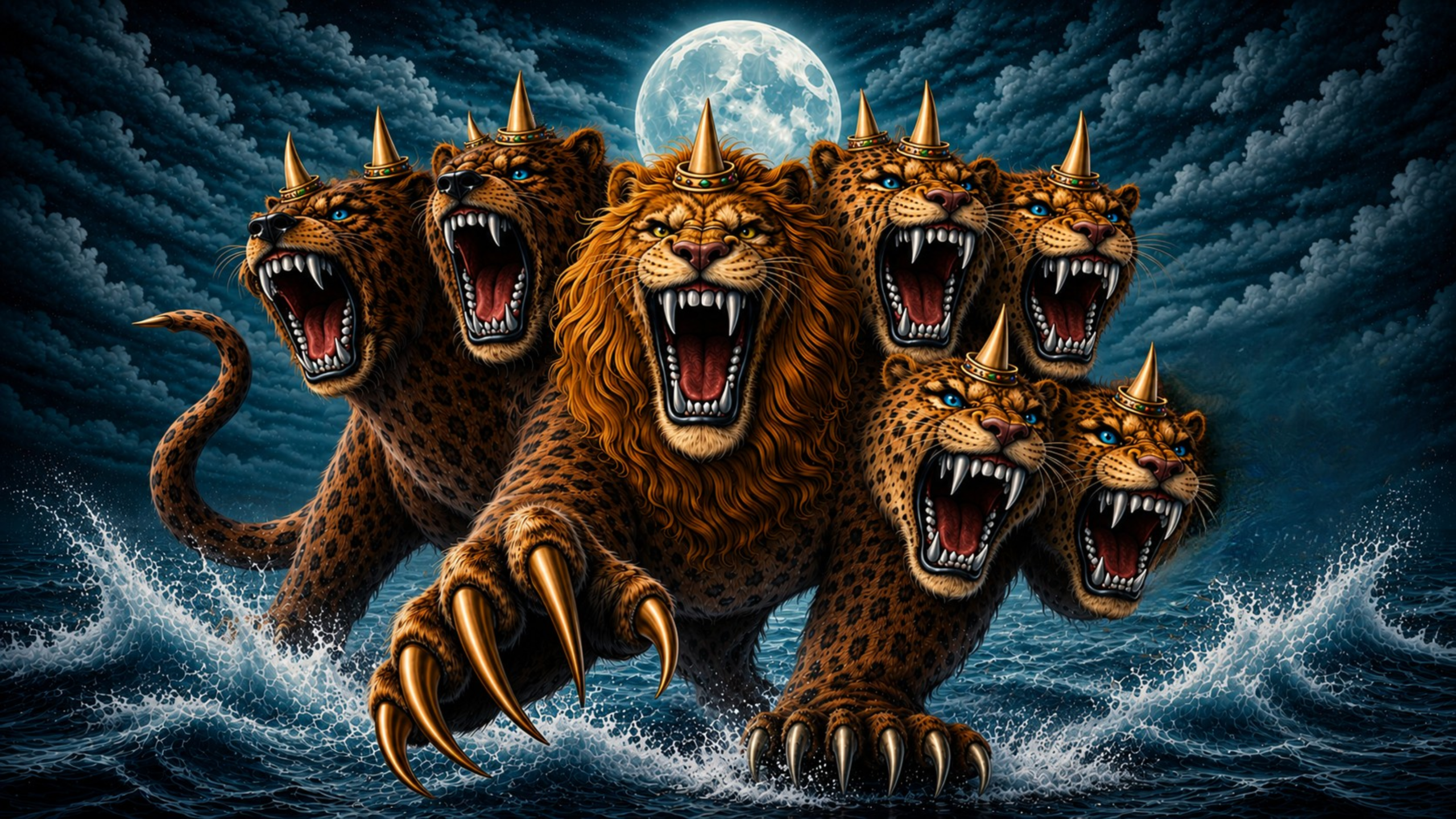
The Prophet Daniel’s vision of the fourth beast contains a detail that is often overlooked. While much attention is given to its iron teeth, the Prophet Daniel also describes the beast as possessing bronze claws.
This detail is significant because bronze immediately connects us back to King Nebuchadnezzar’s dream in Daniel chapter 2. In that vision, the bronze portion of the great statue represented the realm of Greece. Beyond its historical fulfillment, bronze symbolizes the governing spirit associated with that kingdom—a system characterized by persuasion, public participation, debate, and various forms of democratic rule.
The Iron Rod of Christ vs. the Iron Teeth of the Beast
Likewise, the iron of the fourth kingdom carries its own symbolic meaning.
Iron in Scripture is not inherently evil. In fact, the Messiah Himself is described as ruling the nations with a rod of iron.
Psalm 2 declares:
“Thou shalt break them with a rod of iron; thou shalt dash them in pieces like a potter’s vessel.”
Likewise, Revelation describes the Son of God ruling the nations with that same rod of iron.
The iron rod of Christ does not symbolize tyranny. Rather, it represents the unyielding authority of God’s Word and the inevitable consequences that follow when mankind refuses to obey it. God’s truth does not bend to public opinion, cultural trends, or human preference. Like iron, His judgments are firm, His standards are fixed, and His Word remains unbreakable.
This helps us understand the symbolism Daniel is presenting.
The fourth beast is not represented by iron alone. It possesses both iron teeth and bronze claws. This reveals that while the beast itself is the iron kingdom, it also incorporates the bronze characteristics associated with Greece. The final kingdom therefore combines the iron authority of the fourth kingdom with the bronze influence inherited from the Greek system.
The iron teeth symbolize strength, enforcement, and the power to compel compliance. Iron crushes, breaks, and subdues. It represents the ability of governments, institutions, and world systems to impose their will through military power, economic leverage, technological control, surveillance, law enforcement, and administrative systems.
Unlike the silver kingdom, which was characterized by centralized authoritarian rule, the iron kingdom operates through an extensive network of institutions and mechanisms that reach into nearly every aspect of human life. Its power is not merely concentrated at the top; it is embedded throughout the systems that govern commerce, communication, transportation, finance, security, information, and social order.
Iron therefore symbolizes a level of control that is more pervasive and far-reaching. It possesses the ability to monitor, regulate, reward, restrict, and enforce on a scale that previous kingdoms could never achieve. Through military strength, economic systems, technological infrastructure, and institutional authority, the iron kingdom can shape behavior and compel compliance across vast populations.
Yet there is an important distinction between the iron rod of Christ and the iron teeth of the beast.
Both symbolize authority.
But they originate from different sources.
Christ rules through truth.
The beast rules through power.
Christ’s iron rod enforces the will of God.
The beast’s iron teeth enforce the will of men.
Christ’s authority proceeds from divine law.
The beast’s authority proceeds from earthly institutions.
One establishes righteousness.
The other seeks compliance.
The Prophet Daniel’s vision therefore reveals a kingdom that imitates divine authority while directing that authority toward human ends.
The Bronze Claws of the Beast
The bronze claws, however, operate differently.
Claws do not crush like teeth.
They grasp.
They hold.
They influence.
They direct movement.
If the iron teeth symbolize enforcement, the bronze claws symbolize influence and persuasion.
The democratic spirit does not typically begin by forcing compliance. Instead, it seeks consent. It shapes public opinion through rhetoric, education, media, entertainment, political campaigns, social pressure, and cultural trends. It persuades populations to embrace particular ideas, values, and policies.
This has long been one of the defining characteristics of democratic systems. Political power is often obtained not merely through force, but through the ability to influence perception. Elections are won through persuasion. Public narratives are carefully crafted. Information is distributed in ways that guide opinion and behavior.
In this sense, the bronze claws symbolize the power to grasp the minds of the masses.
The final beast appears to combine both methods of governance.
First comes persuasion.
Then comes enforcement.
The bronze claws shape public thought and build consensus. Once consensus has been achieved, the iron teeth enforce the resulting system.
This pattern can be observed repeatedly throughout history. Societies are often conditioned gradually to accept new ideologies, regulations, and structures. What begins as influence eventually becomes policy. What begins as persuasion ultimately becomes enforcement.
Daniel’s vision therefore presents a kingdom far more sophisticated than a simple dictatorship. It is a hybrid system. It possesses the iron strength of centralized authority while simultaneously employing the bronze influence of democratic persuasion.
This may also help explain why the beast of Revelation appears as a composite creature, possessing characteristics of the lion, bear, and leopard that came before it. The final kingdom inherits governing principles from previous kingdoms and combines them into a single global structure.
The iron teeth and bronze claws work together.
One controls behavior.
The other shapes belief.
One governs through enforcement.
The other governs through influence.
One compels obedience.
The other manufactures consent.
Together they form a system capable of reaching both the actions and the minds of the people it seeks to rule.
Conclusion
Daniel’s description of the fourth beast possessing both iron teeth and bronze claws provides a remarkable insight into the nature of the final kingdom. The iron teeth reveal a system capable of enforcing compliance through powerful institutions, military strength, economic mechanisms, technology, surveillance, and the systems of the world. The bronze claws reveal a parallel ability to influence public opinion, shape beliefs, and persuade populations through narratives, culture, and democratic participation.
Together, the iron teeth and bronze claws portray a kingdom that seeks to govern both actions and thoughts, behavior and belief, enforcement and persuasion.
For students of prophecy, this overlooked detail serves as an important reminder that power does not always arrive through open oppression. Often it begins through influence, consensus, and persuasion before eventually manifesting through enforcement and control.
The bronze claws of the beast may therefore be one of Daniel’s most important clues concerning the character of the fourth kingdom in the last days.
Continue Your Study
If you found this study helpful, we invite you to continue exploring the prophetic symbols of Daniel and Revelation with us.
In related articles on our website, you can learn more about:
- The Ten Horns of the Fourth Beast and their role in the final kingdom.
- The Seven Heads of the Beast and the prophetic kingdoms they represent.
- The relationship between Daniel’s fourth beast and the Beast of Revelation 13.
- The connection between Nebuchadnezzar’s statue, Daniel’s beasts, and the Kingdom of God.
These prophetic symbols work together to reveal a larger picture of the kingdoms of this world and the coming Kingdom of God.
If this article has blessed you, consider sharing it with others who are seeking a deeper understanding of Bible prophecy. Feel free to leave a comment, subscribe to our updates, and explore our other studies as we continue examining the mysteries revealed to Daniel and John.
May the Spirit of Truth guide you into all understanding.

Be First to Comment